Home Project Calculator › Deck Calculator
Deck Calculator
Enter your deck dimensions, the board width you are using and your joist spacing. The calculator returns decking boards, joists, beams, footings and fasteners — the framing and the surface separately.
How the deck math works
A deck is two estimates stacked: the frame underneath and the surface on top. They use different units and different spacing rules, so calculating them together is where errors creep in.
Decking boards are a width problem. Take the deck width in inches, divide by the board width plus the gap you are leaving, and that is the boards per row. A 5½" board with a ¼" gap covers 5¾" of run, so a 12 ft width needs about 25 boards per row.
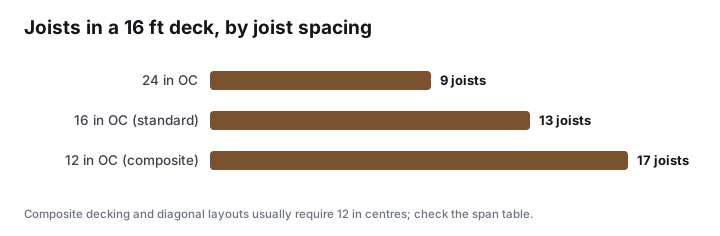
Joists are a spacing problem. Sixteen inches on center is standard for most decking run perpendicular to the joists. Diagonal decking, or thinner composite boards, usually require 12 inch centers — check the decking manufacturer's span table, because composite spans are often shorter than lumber.
Footings carry the whole structure and are governed by beam span and soil, not by a rule of thumb. This is the part of a deck that is genuinely structural, and in most jurisdictions it is also the part that triggers a permit and an inspection.
What throws the estimate off
Gaps matter more than they look. A ¼ inch gap across 25 boards is over 6 inches of deck width — enough to change your board count and to leave you short if you ignored it.
Composite and wood behave differently. Wood shrinks as it dries and can be laid tighter; composite expands with heat and needs its specified gap, both between boards and at the ends.
Fasteners add up fast. Two screws per board per joist is the standard, which on even a modest deck runs into four figures. Hidden fastener systems have their own coverage rating per square foot.
Deck calculator FAQ
How far apart should deck joists be?
Sixteen inches on center suits most decking run perpendicular to the joists. Drop to 12 inches for diagonal decking or for composite boards, many of which specify a shorter span than lumber.
How many deck boards do I need?
Divide the deck width in inches by the board width plus your gap. A 5½ inch board with a ¼ inch gap covers 5¾ inches, so a 12 ft wide deck needs about 25 boards per row.
How big a gap should I leave between deck boards?
About ¼ inch for wood, which will shrink slightly as it dries. Composite decking has a specified gap for thermal expansion — follow the manufacturer, because composite moves with temperature rather than moisture.
Do I need a permit to build a deck?
In most jurisdictions, yes — particularly for anything attached to the house or raised above a certain height. Footings, ledger attachment and railings are the parts inspectors look at hardest.
Other project calculators
Every calculator on this site works the same way — enter real measurements, get quantities you can hand to a supplier.
- Fence Calculator — Enter your run length, height and post spacing to get exact post, rail, picket and concrete counts, plus a material cost estimate
- Flooring Calculator — Enter room dimensions to get square footage, waste allowance and the number of boxes to buy for laminate, vinyl or hardwood
- Roofing Calculator — Enter footprint and roof pitch to get roofing squares, shingle bundles, underlayment and ridge cap quantities with a cost estimate
- Paint Calculator — Enter room dimensions, coats and door and window openings to get the exact number of gallons needed for walls, ceiling and trim
- Drywall Calculator — Enter room dimensions and sheet size to get the number of drywall sheets, joint compound, tape and screws needed, with waste included
- Wainscoting Calculator — Enter wall length and panel height to get panel, chair rail, baseboard and cap moulding quantities plus a material cost estimate
Working through a whole project? The full project calculator keeps all seven in one place, and the in-depth guides cover estimating materials accurately and reducing material waste.