Home Project Calculator › Fence Calculator
Fence Calculator
Enter the length of your run, the height you want and how far apart the posts will sit. The calculator returns post, rail, picket and concrete counts, plus an estimated material cost you can take to a supplier.
Fence Material Shopping List
Generated at materialestimator.com
Shows one representative section of your fence. Posts and boards rendered proportionally to your inputs.
How the fence math works
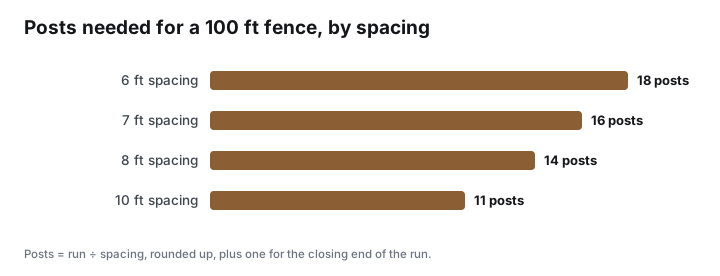
Posts come first, because every other quantity keys off them. For a straight run, the post count is the total length divided by your post spacing, plus one — a 100 ft run at 8 ft spacing needs 13 posts, not 12, because the run has two ends. Forgetting the closing post is the single most common miscount on a fence order.
Rails are counted per section rather than per foot. A 4 ft fence typically uses two rails per section, and anything 6 ft or taller uses three to keep the pickets from cupping over time. Multiply rails per section by the number of sections — which is always one fewer than the post count.
Pickets are a width problem. Convert the run to inches, then divide by the picket width plus whatever gap you are leaving between boards. A 100 ft run of 5½" dog-ear pickets butted tight needs about 219 boards; the same run with a ½" gap needs roughly 201. That gap is worth deciding before you order, not after.
Concrete is sized per hole. A rule of thumb is to set posts one third of their above-ground height into the ground, in a hole three times the post width, which usually lands between one and two 50 lb bags per post depending on depth and diameter.
What throws the estimate off
Slope is the big one. A fence following a grade needs either stepped panels or racked rails, and both consume more material than a flat run of the same horizontal length. If your yard drops more than about a foot across a section, add material rather than trusting the flat-run number.
Gates are not fence. A gate opening replaces a section but adds a heavier post pair, hinges and hardware. Subtract the opening from your picket count and budget for the gate separately.
Corners and ends need bracing. Terminal posts carry more load than line posts, which usually means a wider hole and more concrete at each corner, end and gate post.
Fence calculator FAQ
How many fence posts do I need for 100 feet?
At 8 ft spacing, a 100 ft straight run needs 13 posts — 100 ÷ 8 = 12.5, rounded up to 13 sections' worth of spacing, plus the closing post. At 6 ft spacing the same run needs 18. Always add one post for the end of the run.
How far apart should fence posts be?
Six to eight feet is standard for wood privacy fence. Eight feet uses fewer posts and less concrete; six feet is stiffer and holds up better in high wind or where the fence is carrying a heavy privacy panel.
How much concrete per fence post?
Usually one to two 50 lb bags per post. The hole should be about three times the post width and one third of the post's above-ground height deep, so a 6 ft fence on a 4x4 typically means a 10–12 inch hole about 2 ft deep.
Should I add a gap between fence pickets?
A small gap — around ¼ to ½ inch — lets the boards expand and dry, which reduces cupping and warping. Butted-tight boards look better on day one but tend to move more over the first season. The gap also reduces your picket count.
Other project calculators
Every calculator on this site works the same way — enter real measurements, get quantities you can hand to a supplier.
- Flooring Calculator — Enter room dimensions to get square footage, waste allowance and the number of boxes to buy for laminate, vinyl or hardwood
- Roofing Calculator — Enter footprint and roof pitch to get roofing squares, shingle bundles, underlayment and ridge cap quantities with a cost estimate
- Paint Calculator — Enter room dimensions, coats and door and window openings to get the exact number of gallons needed for walls, ceiling and trim
- Deck Calculator — Enter deck size, board width and joist spacing to get decking board counts, joists, beams, footings and fastener quantities
- Drywall Calculator — Enter room dimensions and sheet size to get the number of drywall sheets, joint compound, tape and screws needed, with waste included
- Wainscoting Calculator — Enter wall length and panel height to get panel, chair rail, baseboard and cap moulding quantities plus a material cost estimate
Working through a whole project? The full project calculator keeps all seven in one place, and the in-depth guides cover estimating materials accurately and reducing material waste.