Home Project Calculator › Drywall Calculator
Drywall Calculator
Enter your room dimensions and the sheet size you are using. The calculator returns sheet count, joint compound, tape and screws — including the waste that comes with cutting around openings.
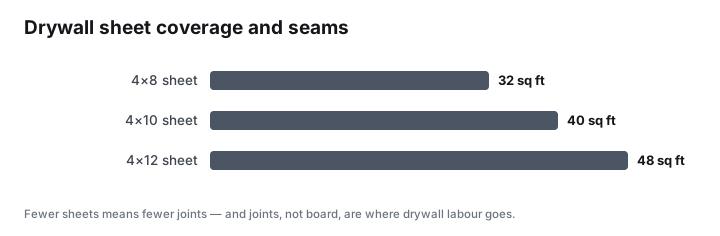
How the drywall math works
Start with total surface: wall area plus ceiling area if you are covering it. Then divide by the coverage of a single sheet. A 4×8 sheet covers 32 sq ft and a 4×12 covers 48, which is why bigger sheets are worth handling on long walls — fewer sheets means fewer seams to finish.
Seams are the real cost of drywall, not the board. Every joint has to be taped, mudded, sanded and usually mudded again, so the layout that minimises seams saves far more labour than it saves material. On a 12 ft wall, one 4×12 sheet beats one and a half 4×8 sheets by two joints.
Joint compound is estimated per sheet rather than per square foot. Plan on roughly a gallon of all-purpose compound per three to four sheets across taping and two finish coats. Tape runs about 40 linear feet per sheet in typical layouts.
Screws run roughly 32 per sheet on walls at 16 inch framing — every 12 inches in the field and every 8 inches on the edges. Ceilings need more, because gravity is working against you.
What throws the estimate off
Waste on drywall is unusually high, often 10–15%, because cutouts around doors, windows, outlets and switches rarely produce a reusable offcut.
Ceiling sheets are a different job. They are heavier overhead, need more fasteners, and generally want a helper or a panel lift regardless of what the sheet count says.
Moisture and fire-rated board are not interchangeable. Bathrooms and garages usually require a specific board type by code, and it is priced differently.
Drywall calculator FAQ
How many drywall sheets do I need?
Divide your total wall and ceiling area by the sheet coverage — 32 sq ft for a 4×8 sheet, 48 sq ft for a 4×12 — then add 10–15% for cutting waste around openings.
Should I use 4x8 or 4x12 drywall sheets?
Use the longest sheet you can safely handle. Longer sheets create fewer seams, and seams are where drywall labour actually goes. On a 12 ft wall a single 4×12 avoids two joints.
How much joint compound do I need per sheet?
Roughly one gallon of all-purpose compound per three to four sheets, covering taping plus two finish coats. Textured finishes and skim coats use noticeably more.
How many screws per sheet of drywall?
About 32 per sheet on walls with 16 inch framing — spaced every 12 inches in the field and every 8 inches along the edges. Ceilings take more.
Other project calculators
Every calculator on this site works the same way — enter real measurements, get quantities you can hand to a supplier.
- Fence Calculator — Enter your run length, height and post spacing to get exact post, rail, picket and concrete counts, plus a material cost estimate
- Flooring Calculator — Enter room dimensions to get square footage, waste allowance and the number of boxes to buy for laminate, vinyl or hardwood
- Roofing Calculator — Enter footprint and roof pitch to get roofing squares, shingle bundles, underlayment and ridge cap quantities with a cost estimate
- Paint Calculator — Enter room dimensions, coats and door and window openings to get the exact number of gallons needed for walls, ceiling and trim
- Deck Calculator — Enter deck size, board width and joist spacing to get decking board counts, joists, beams, footings and fastener quantities
- Wainscoting Calculator — Enter wall length and panel height to get panel, chair rail, baseboard and cap moulding quantities plus a material cost estimate
Working through a whole project? The full project calculator keeps all seven in one place, and the in-depth guides cover estimating materials accurately and reducing material waste.